
Archaeology
The Rooiels coastline and mountains have quietly preserved traces of human activity for thousands of years. Evidence shows that this was never a heavily populated area. Its rugged terrain and limited grazing made permanent settlement in large numbers difficult, but people did live here, exploiting the rich coastal and fynbos resources.
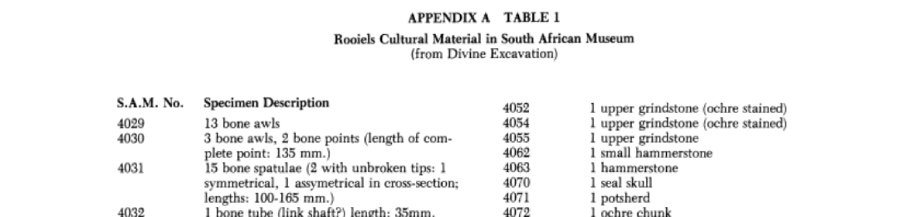
The Rooiels Cave, tucked into the cliffs above the beach, has been the site of several notable excavations. The first, conducted by Arthur Devine in 1912, was carried out with methods which were, by modern standards, chaotic, amateurish and destructive. Devine reported that he had found numerous “relics”, including eleven human skeletons. Some of the shell and stone tools he collected can be found in the South African museum, but not the skeletons.
In 1922, Keppel Barnard came to dig the cave, and found shells, tools and pottery. The finds were not documented scientifically.
It wasn’t until 1979 that the cave received careful scientific attention. Archaeologists Andrew B Smith and Graham Avery systematically documented the layers, leaving a central unexcavated vertical strip to preserve the stratigraphy. They found decorated ostrich shell beads, stone scrapers and other tools. The bones of hippopotamus, otters, seals, albatross and flamingo were found. The artefacts were dated from 5,000 years ago, right up to the 19th century.
Beyond the cave, Rooiels has other archaeological traces. Shell middens (ancient heaps of discarded shells and bones) dot the coastline, evidence of repeated visits by hunter-gatherers exploiting the abundant marine life. In some of the tidal rocks, ancient fish traps still hint at the survival strategies of early coastal communities, showing how they manipulated the landscape to catch fish during low tide.
Taken together, the finds in Rooiels reveal a landscape lightly but deliberately used over millennia. People came to the area to gather, hunt, and fish, and while the terrain likely prevented dense settlement, the archaeological record shows evidence of trade, tool-making, skillful use of natural resources and repeated human presence over generations.
📘Rooiels: A history and other stories by Rita Blake chronicles the early history and archeological legacy of Rooiels.
📄An Archaeological Investigation of Holocene Deposits at Rooiels Cave, South-Western Cape